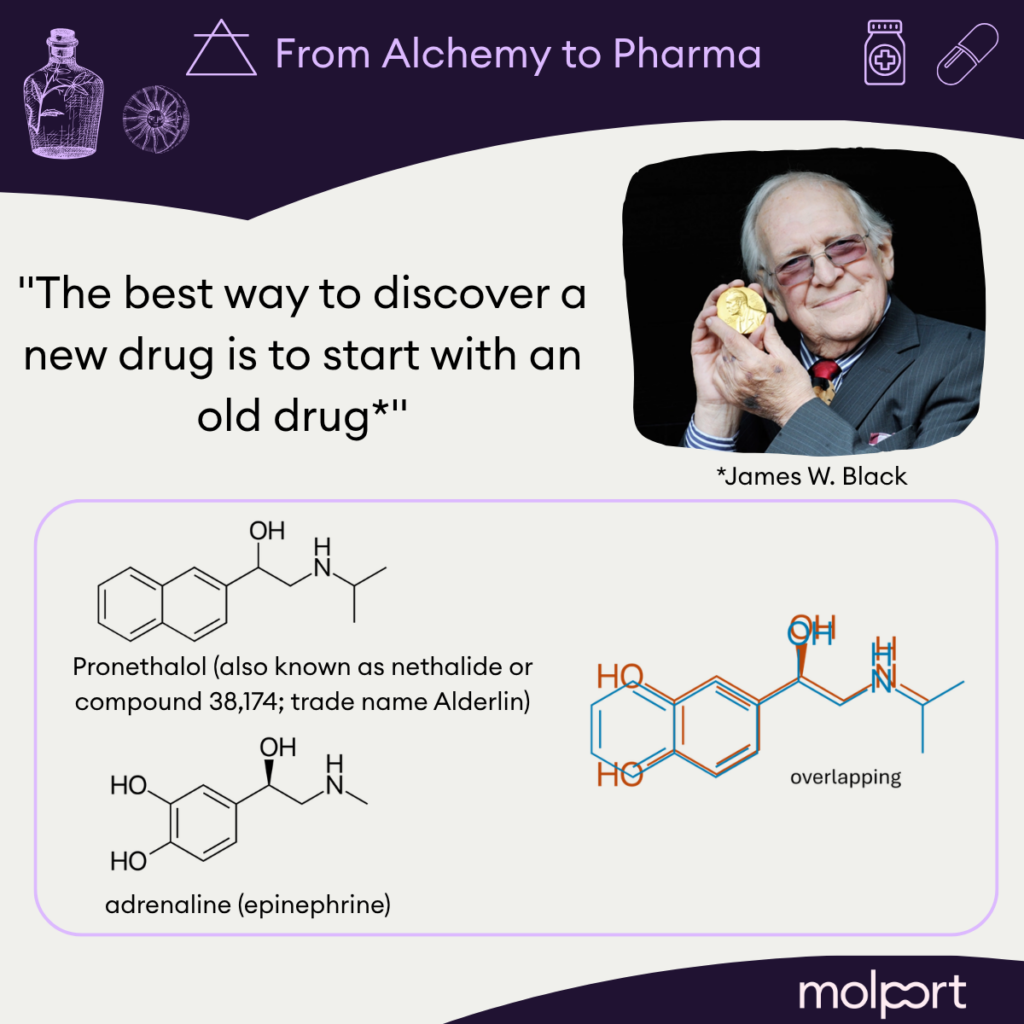
The best way to discover a new drug is to start with an old drug
1958 – A massive medicinal chemistry milestone begins
In the late 1950s, angina (chest pain caused by reduced blood flow to the heart) had limited treatment options. In 1958, Sir James W. Black joined ICI Pharmaceuticals with an idea that would reshape cardiology – and become one of the biggest milestones in medicinal chemistry.
1958: The hypothesis (not luck)
Black reasoned that angina isn’t only about improving blood supply – it’s also about reducing the heart’s oxygen demand.
So he focused on a clear biological driver: adrenaline (epinephrine) makes the heart beat faster and harder, therefore blocking that signal could protect the heart
That meant going after the beta-adrenergic receptor – a target defined by pharmacology and physiology, long before we had protein structures and today’s computational tools.
1963: First proof
After years of iterative chemistry + pharmacology testing (not random screening), Black’s team delivered pronethalol – the first clinically useful beta-blocker.
It proved the concept, even though it was later withdrawn due to safety concerns.
1964: The breakthrough molecule
Next came propranolol, a more effective and safer beta-blocker – the compound that truly changed the field.
~1965: A medicine that reshaped cardiology
Propranolol was launched as Inderal, and beta-blockers soon became foundational for treating angina, arrhythmias, hypertension and many other cardiovascular conditions.
1988: Global recognition
James Black received the Nobel Prize in Physiology or Medicine for pioneering principles of drug treatment – including the work that led to beta-blockers.
Beta-blockers weren’t found by chance.
They were built from a hypothesis, aimed at a target, and proven in patients.
Other Molport Chronicles posts- from Alchemy to Pharma:
- Everyone, calm down! Benzodiazepine history
- Eli Lilly: From Civil War Roots to Global Pharma Leader
- Toxicology and Preclinical Testing (Animal Models)
- Dose Makes The Poison
- Oldest Pharmacy
- From Apothecary to Alkaloid Pioneer: The Origins of Merck and Modern Drug Discovery
- GSK legacy shaped by Beecham’s Pills and Research Laboratories
- The journey of ASPIRIN
- The footprint of Bristol-Myers Squibb (BMS)
- BASF: From dyes to drugs
#DrugDiscovery #BetaBlockers #MedicinalChemistry #HistoryOfMedicine